Steventon
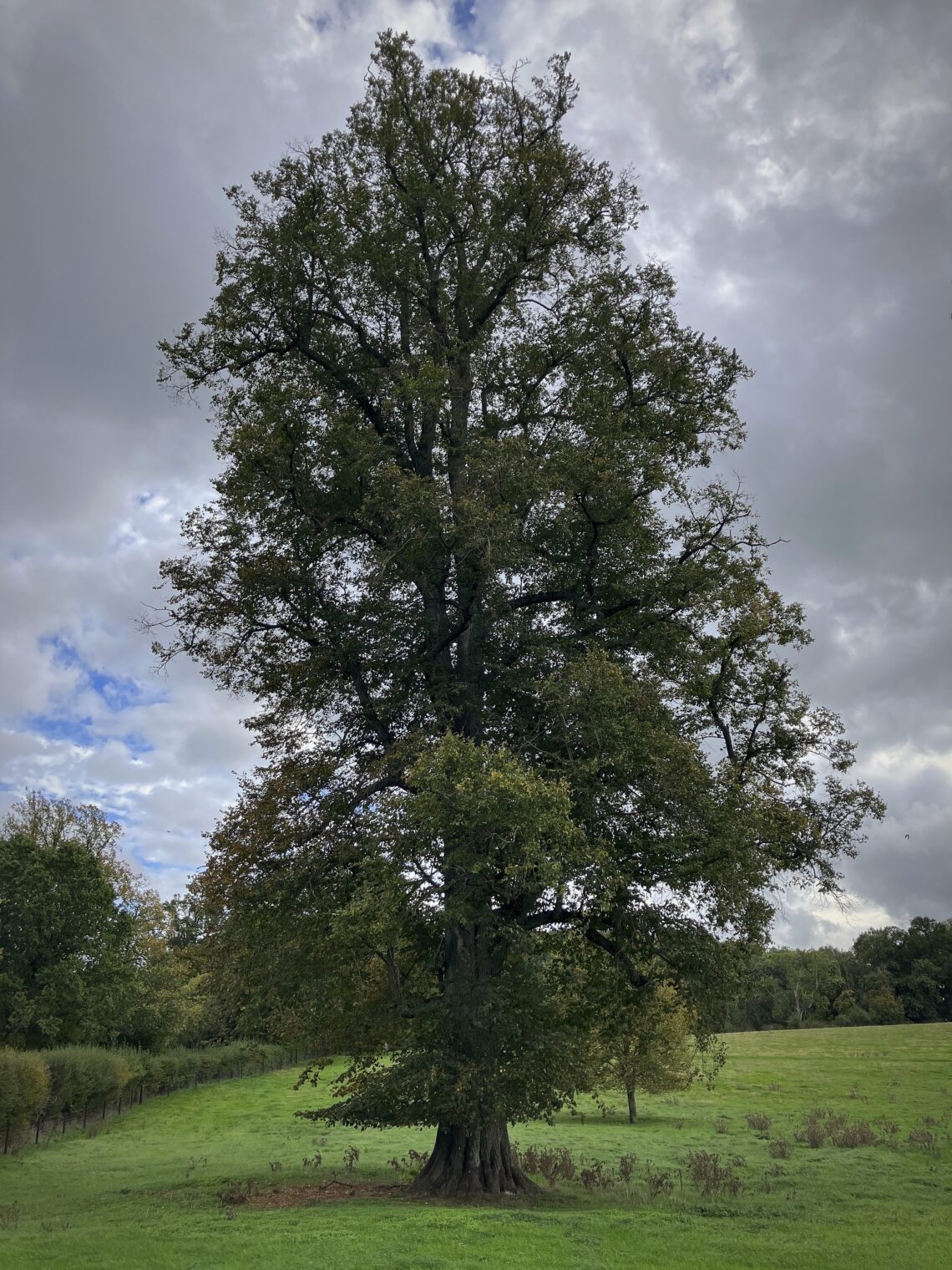
Jane Austen’s birthplace no longer stands, but this tree was planted there by her brother while she lived.
In fact, her brother, the eldest of the family, seems to have had the greatest presence in Steventon, and Overton, the nearest market town. He became an ordained minister of the Church of England, like their father, and took his place in the parsonage where Jane was born after her father retired and took his wife, Jane and her sister to Bath. He was also the rector at the much bigger church in Overton, and his home in the parsonage there still stands, and is quite impressive. He fancied himself highly literate, with his Oxford education, and apparently wrote a great deal of poetry, which nobody ever reads. His second wife was Mary Lloyd Austen, the woman who Jane disliked, and who was cruel to her stepdaughter, one of Jane’s favorite nieces. I think she was a model for Mrs. Norris, the infamous mean girl in Mansfield Park. But I’ll try not to bore you with too much Austen lore, as I don’t expect people to have read her, or not as much as I have.
I drove first to Overton, in my rented Peugeot, Henri. It was nerve wracking, on tiny country roads and a stick shifter in my left hand, because of course now we drive on the left, and sit on the right.
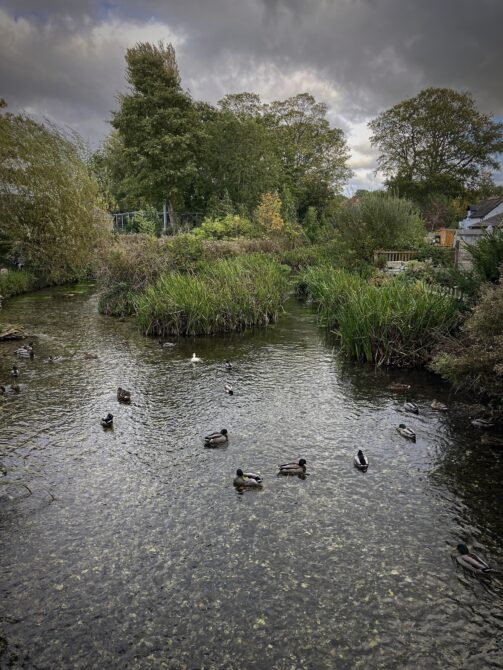
Overton is on the River Test, which you can see is really a creek, but lovely with the backs of homes and buildings sloping down to it. I parked at a pub on the high street called The Red Lion, that is very old and was visited by King George IV, supposedly. The publican, David, was classic, blue-eyed, brown toothed English, with a snaggly grin. He talked about how over ten thousand people have been arrested for simply posting their opinion on X, saying that, even if it is factual, it is illegal to say anything that might offend a minority group. And yes, they are squeezing pubs with increasing taxes and other changes that are putting them out of business. He said he might not last another year or two. He believes it is deliberate, because, as he pointed out, it is in pubs where conversations like ours happen. He served me a very good BLT and really excellent freshly cooked fries, and was so touched at my 20% tip he almost seemed overwhelmed.
I then walked across the charming little River Test, and up to the church where Jane’s brother James was rector. When I stopped in front of the church to take a picture, an elderly woman who was bicycling by said hello, and stopped to ask if she could help me find anything. Then an older couple who seemed to be coming for a walk joined us, and she introduced me to them. They all spoke in the same accent, very different from David’s at the pub, and I think rather posh. She said she was born at Lower Ashe Farm, a listed place on maps from Jane Austen’s time. They all talked about how terrible these extreme right people are, and the horrible things they want to do to the country. I wonder if they know their local publican is a terrible guy.
The woman on the bicycle showed me the sights I was looking for, and directed me down a lane that crossed back over the river and had nice thatched houses. I thanked her, and she trilled “Have a lovely day, bye bye!” as she rode away, sounding exactly like Mary Poppins.
I drove on to Ashe, and then Deane, but there was not much you could see, it all being behind brick walls. The main thing I got was that Jane was certainly a champion walker, if she visited all these places regularly, as she was said to do, on foot. A nine mile walk there and back just to get the mail in Overton.
Finally, I turned up a little road and saw the site where her home, from birth to age 25, had stood. The fenced area protects the house’s well, and you can see a patch of disturbed grass that is where archeologists have done a dig to establish the footprint of the house. 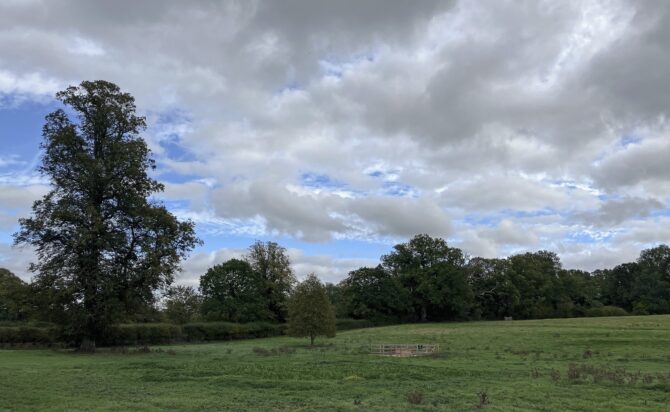
It is surrounded by hedgerows, but people have made holes right where you need them for views of what little is there. I squeezed into one hole to get a shot of today’s featured photo, which amused me.
I then turned up a lane to go to the church where the Reverend Austen presided. It is very, very small, rather ugly, and rather cold. It was built by the Normans in the 1200s, and still holds monthly services. I find it very impressive how quickly they united everyone, no matter how in the middle of nowhere, by a church, no matter how small. I bet that form of surveillance was more effective than the kind we are worrying about now.
We can unplug, but they had to show up and be told what to do.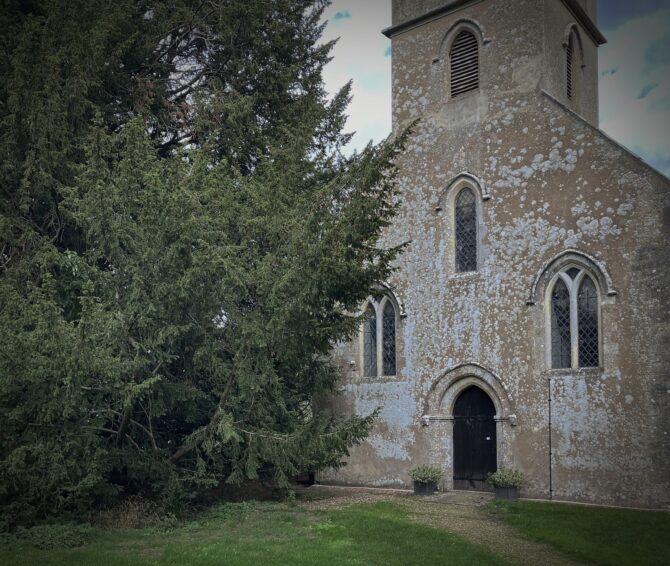
James and Mary Austen are buried in the churchyard, around back. I, perhaps uncharitably, grudgingly admit that his commitment to his home was admirable. I read that he planted that impressive tree with his son, and wrote a poem to commemorate it called “To Edward On planting a lime tree on the terrace in the meadow before the house” Ambitious and pretentious as he or his wife may have been, he stayed right there, and chose that obscure spot as his eternal resting place. That is a statement.
Most of the tombstones are blank now, from rain and lichen. Not a one is standing upright, and they lean out and in, much like David the publican’s teeth.
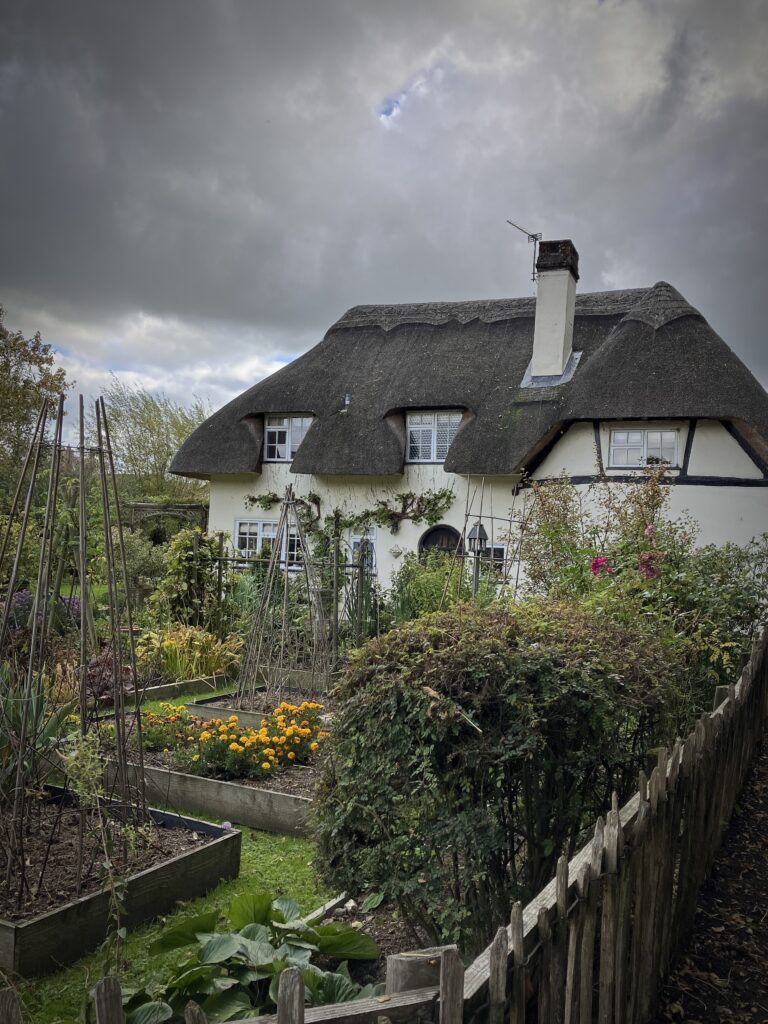
As a reward for tolerating my niche obsession, I leave you with a photo of some cottagecore from the lane to the River Test. Its backyard is bordered by the river, and laundry was hanging out on the line. My bicycle-riding dame told me that the man who did the thatching won a national prize for it.