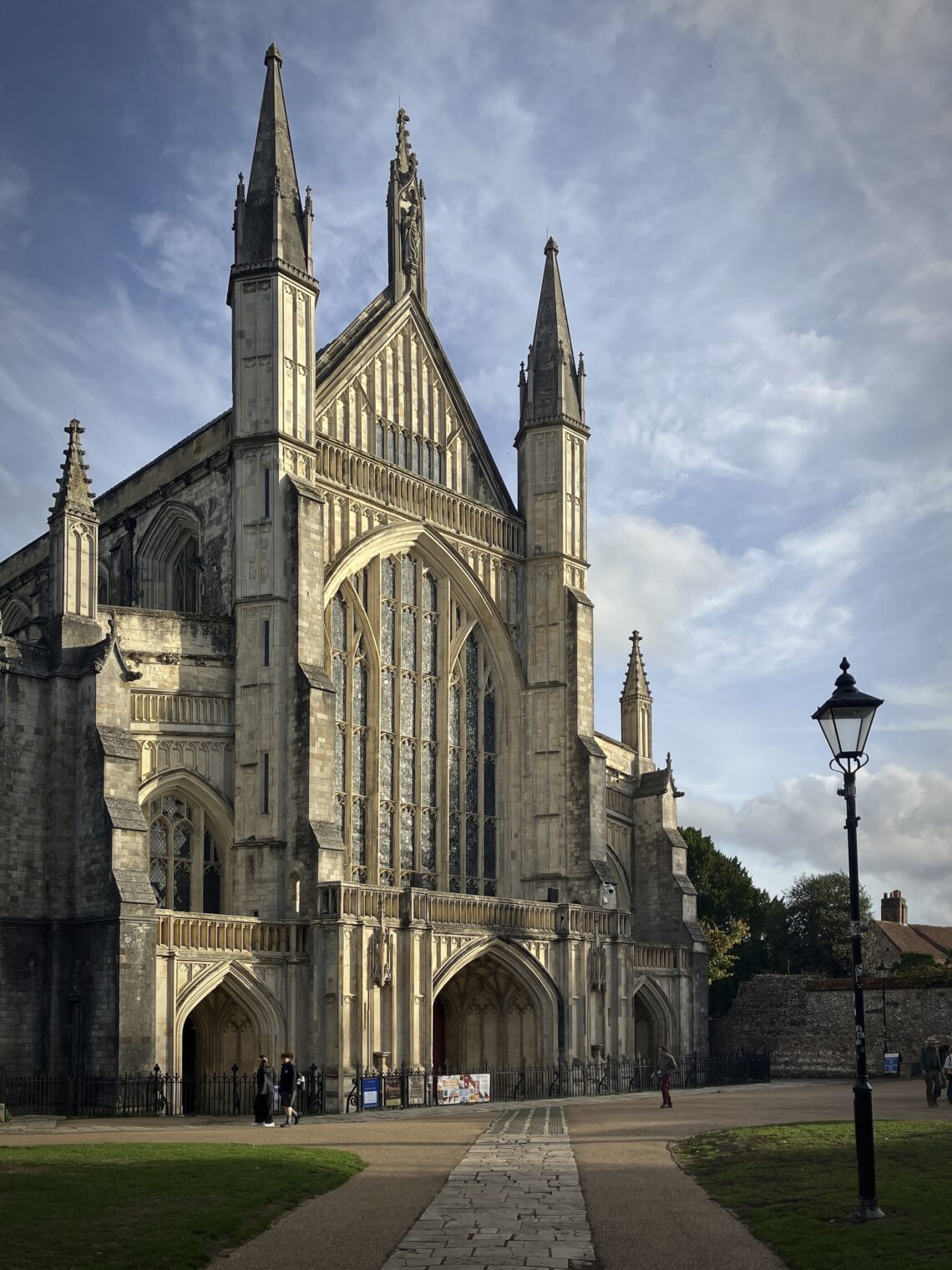
Winchester
I arrived yesterday, but England still feels surreal to me.
Is it the sudden plunge into using English as a default? Is it because of generations of family nostalgia? Is it because of my lifetime veneration of, and saturation with English literature? Or, is it really because these people are living in a state of denial in that has never been equaled? The first three, after all, should really just engender delight for me.
The trip by train from just south of the middle of France was over most familiar ground. I was greatly anticipating the plunge into 30 miles of darkness while we went underneath the English Channel, but that was over fairly quickly and I dozed in bits throughout. The train goes underground much further away from the coastline than I had imagined it would, and with no warning down we went, and popped up in landscape that looked fairly similar to that which we had left. Farms, big box ugliness, and too much new housing blight made worse by peak architectural banality.
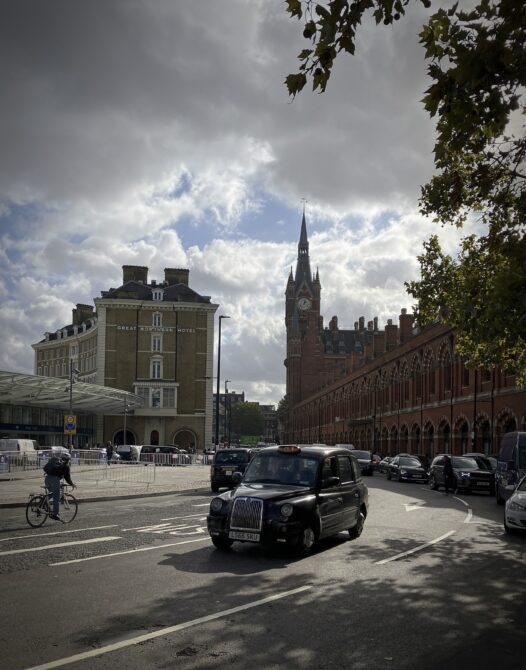
We arrived at St. Pancras (now “International) Station, where I transferred via The London Underground to Waterloo Station. But first I stepped outside to see how it looked these days. It looks much better than it did in 1989, the last time I was in this country. Then, it looked Victorian-haunted: bleak, soot-stained, and nearly deserted. Now, it is bustling and expensive. But the cabs look the same.
Now I’m in Winchester, in a small old hotel, and very pleased with it all. I had time yesterday to take a walk in the charming town, and found the famous cathedral, which is today’s featured photo. Jane Austen, who is the focus of the first part of this visit, is buried here under the floor of one aisle.
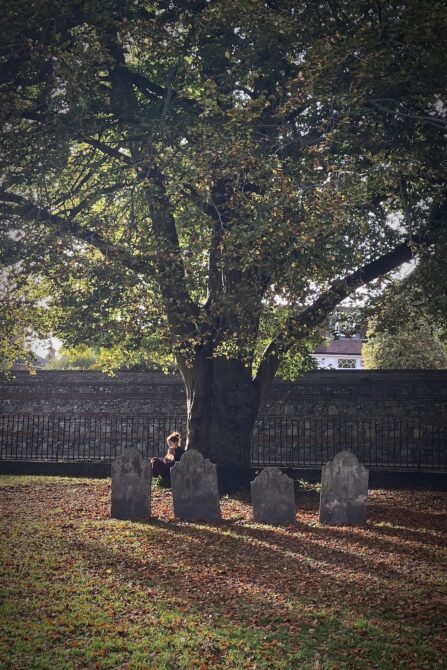
The cathedral, which is very, very old, faces a small quadrangle that is randomly sprinkled with tombs. People were enjoying the afternoon, perhaps on a graveyard? Where are the rest? Are we recreating on top of them? It was an excellent ambiance for an October contemplation of death, and yes, horror. Not that the English seem to indulge in feeling real horror.
Yes, I’m making pronouncements on an entire nation within less than 24 hours. But they are not uninformed pronouncements.
I entered the cathedral on a mission, because I get impatient with all the subtleties that make one cathedral different from another. There were a fair amount of tombstones embedded in the floor, and I quickly tired of reading their faint, scratchy script in hopes of finding Miss Austen’s. So I accosted a tall nun, who may or may not have been just a weirdo doing cosplay, in an elaborate set of wimple and gowns. She gave me directions in the correct, hollow, creaky English-accented voice, and I breezed past the striking altar (you’ll have to do your own research, you know me) and hustled back down the other aisle. But when I really did approach her grave, my breath was taken away, just a bit.
I’ve seen many photos, but here is my own. I am including a fancy wall plaque installed later by her family, that reluctantly acknowledges the fame she had achieved, and doubles down on the lie that she was not at all an irreverent, extremely sharp-tongued teller of highly unpleasant truths, and deeply felt delights.
First, the original grave, with no mention of her writing, even though the future King George IV invited her to dedicate a book to him, during her lifetime obviously.
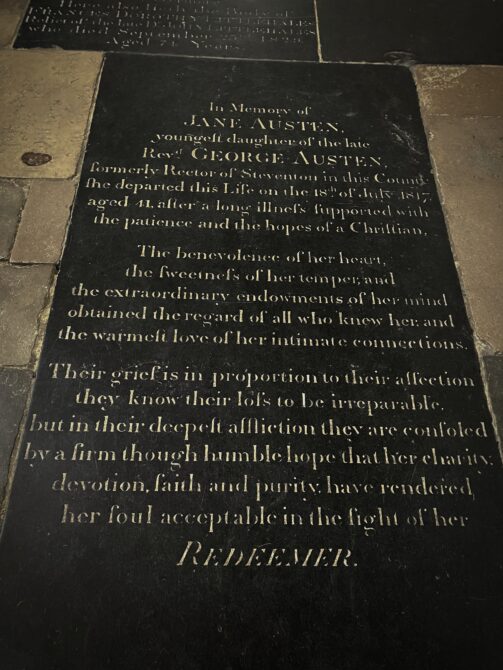
Next, the gaudy evidence that indeed, the family doth protest too much, and hire apologists to continue doing so to this very day. Talking to you, Deirdre Le Faye. The original tomb uses that odd way of making some ‘s’ look like small ‘f’s. Confusing.
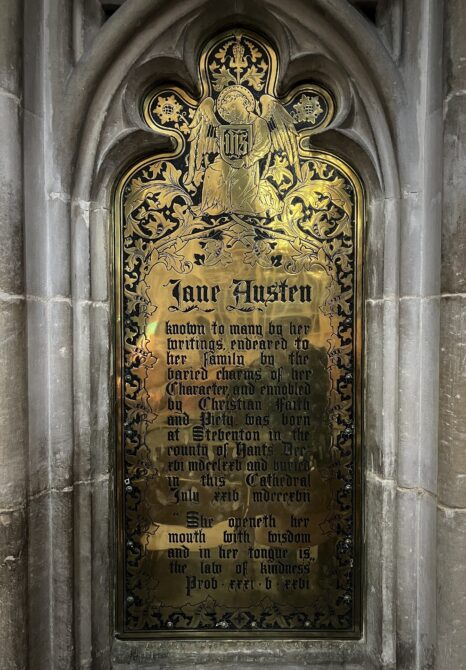
I will tell you frankly that I think Jane Austen’s greatest love, to whom she wrote her books, was a woman named Anne Sharpe. Moreover, I subscribe to the theory that she was murdered with arsenic, by her sister-in-law Mary Lloyd Austen. There is much research dedicated to the coded story of these things, embedded in all of her novels, and even how she disguised it in plain sight. She was simply a passionate genius. I read these epitaphs with disgust.
I emerged from the minster walls and went in search of food and drink. I had a quaint old pub in mind, but was arrested on a street corner by a small pub that was dedicated to tacos and beer. Mexican food is still quite rare, at least in France, because it is so difficult to replicate. I satiated my hunger and thirst with decent tacos and yes, a sublime pint of English IPA. Not a food blog, but Europeans and Brits make alcohol with a mastery I would say can’t be experienced anywhere else.
I also experienced a real-life demonstration of a good reason the English are not reproducing at a “replacement” rate. From my high stool in a corner, I observed a group of young men, early- to mid-thirties or so, standing about waiting to order. They were clean cut and baby-faced and held themselves in slightly awkward postures. They joked about, and then were joined by a posse of women their age, brassy as hell, who loudly commandeered several tables that lined the wall just in front of me. The men sat down with them, and as the women were off ordering, I heard them mildly talking to one who had been promoted to ‘associate,’ and so figured they were either lawyers or maybe accountants. This is a very expensive town, and very white (unlike London), so that would fit. The women returned, and their conversation was so many decibels higher than the men’s, that that became all I heard the rest of my meal. A woman bought a round for all, and announced very loudly that it was all to be “expensed” so many times, I lost count. In spite of some obviously professional status, the women wore plunging necklines, so I got to enjoy some very nice cleavage.
The sexes sat together, but separated respectively. I studied the young men, because they look so different from the Frenchmen. They had a strangely young and diffident air. They could not have looked weaker, privileged though they no doubt were. The women could not have been more obnoxious, liberated as they no doubt are. This country is a disaster.
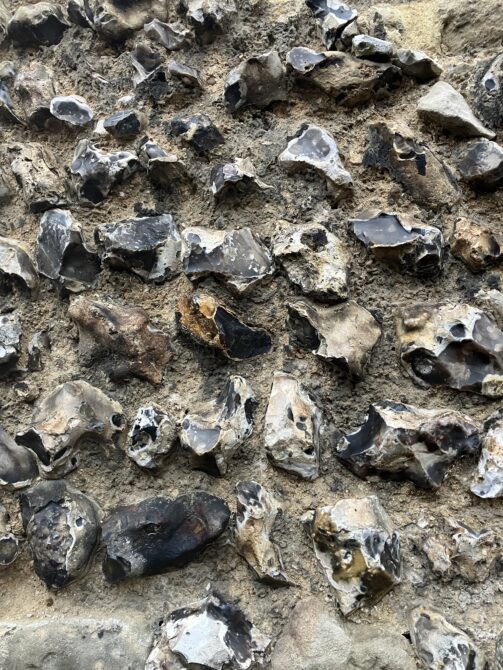
This morning, I embarked early on a brief walk to the house in which Jane died, which was on the other side of the cathedral minster. The minster is surrounded by a very high, thick wall that is made of “flints,” a southern England alternative to the more common red brick for building nearly everything. They give a raw and more elemental character, and I love them because the house in which my grandmother was born is made of them. Woodcote Cottage in Sussex. Her father actually lived here for a while, before his father’s continuing disgraceful behavior sent them all packing for Canada. The famous ‘remittance man’ phenomenon.
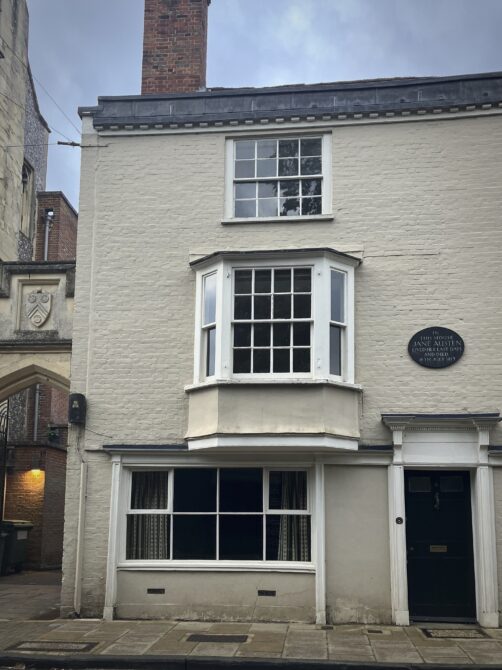
A few very quaint and gothic little streets later, and I came to 8 College Street, and the house. It was early, and quiet. I stood there, and briefly caught the luxurious scent of old, autumn roses growing next to the minster walls. I looked at the window of the room in which Jane finally expired, and thought of the oddness of that sister-in-law coming with them to Winchester to help nurse her. They hated each other, and she was notoriously stingy with her help to her female Austen in-laws. I felt the horror of living a lie and never being able to tell it out loud. I thought of Emily Brontë showing a still willfully-blind nation the truth of their future in Wuthering Heights. Of Tolkien trying to recreate the England he loved, pleading for it to be renewed. Of C.S. Lewis trying to inspire the new generation with a love for the old ways. Of Roald Dahl bitterly imagining the comeuppance of the nastiness of the culture. Of Richard Adams making them all fat, sleek rabbits awaiting the noose at Cowslip’s Warren in Watership Down.
I wondered if my English ancestors have been living a lie for a very long time. Shakespeare’s most famous play is about a lie that indicates that something is “rotten in Denmark,” isn’t it?
