Out To Finistère
There was a part of the Breton coast I hadn’t seen on all of the influencer’s lists.
It was nestled at the end of Brittany, in Finistère, between the more celebrated north and south coasts. With not too much of a detour on our way back to Quimper, I swung Hans over to the villages near the Armorique Natural Regional Park. It seems to be definitely less trammeled. The very first beach we came upon after leaving Perros-Guirec, which was not technically in Finistère but just about, was at a town called St. Michel-en-Grève. We had been going through farmland and then dipped down where there was a little square by the road, full of old men just watching us go by. No multi-story condos, just the beach. There was a moribund little playground next to the sand that had two or three toys to play on. A closed-up snackbar. Your basic family beach in the country that you might go back to every year if you were French.

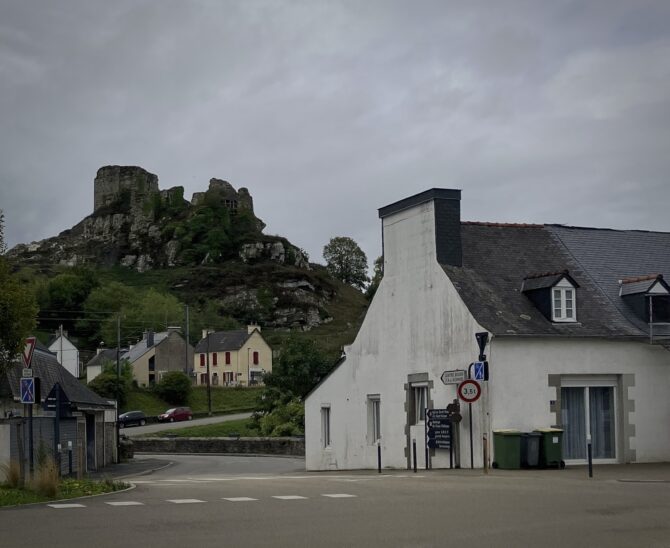
I instantly thought that this was more like it. Then we carried on. Traversing rolling farmland, we dropped down into the valley of the River L’Elorn and there was a nice, big rock that this time had the ruins of a castle on top. The community below the rock was very peaceful and pleasant.
By now I was keeping an eye out for a place to have lunch, but the next town was strangely full of people looking to do the same thing. It was a rather unattractive town nowhere in particular, and I do not remember the name of it. Just odd.
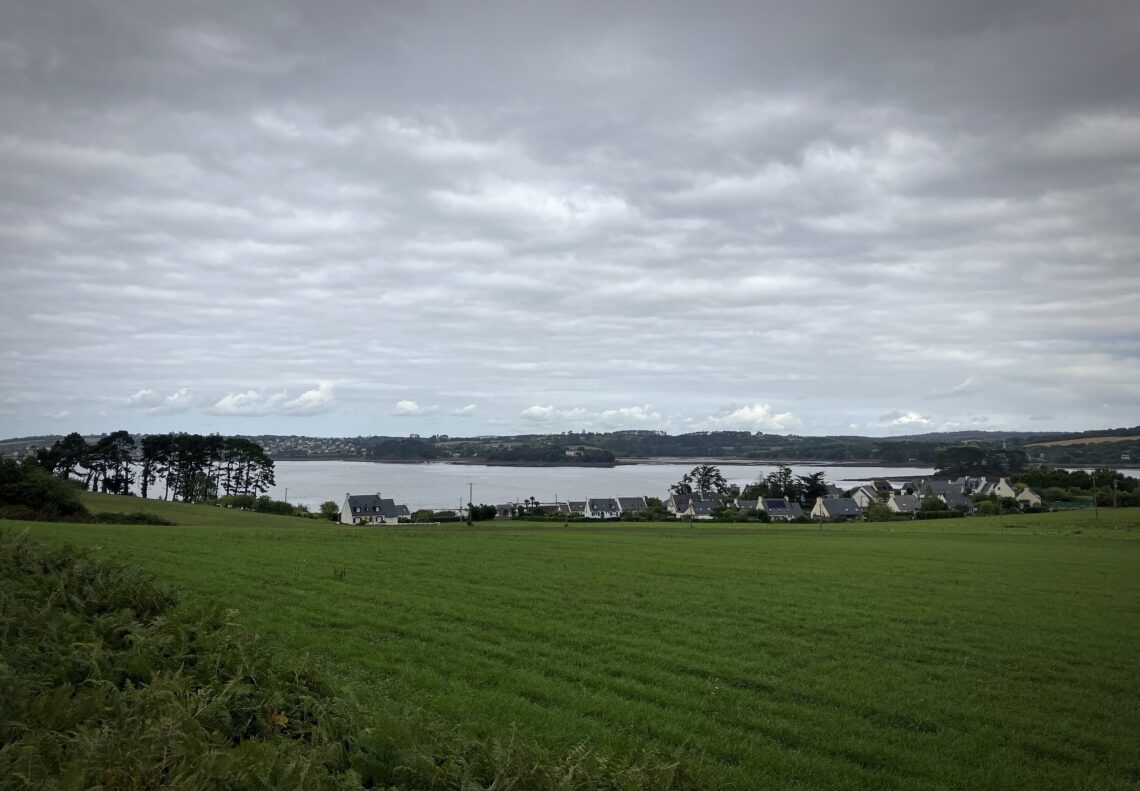
So we carried on into the area within the Armorique Natural Regional Park, and soon saw water. Our featured photo is taken where the Atlantic Ocean comes into a very large inlet, of which this shows the tip at the eastern end. There has been a drought in Bretagne too this year, but it still has remained more green than down south.
The first restaurant was a wooden shed by the water, where they processed and sold shellfish, but all the tables were reserved. Heading down the road we rounded a big, thickly wooded point and there was a new bridge that looked so out of place I jumped a little.
However, it also had a restaurant in a little stone house, with a nice covered patio that overlooked the bridge and the river below. The bridge is the Pont de Térénez.

I ordered oysters on the half shell and some Atlantic salmon smoked over oak by the chef there. I’m sure the salmon was farmed but it was so unctuous and delicately flavored I can’t say I mind. There were entertaining guests, like the three very pot-bellied men who each ordered two dozen oysters. No wonder the poor little man who had just tried to order them was told that they were out of them. Six platters soon came to these guys’ table and I couldn’t help but think they should have spared the little guy a few.
They were indeed good, and the local cider went nicely with them. No, not a food blog! But just let me say this: rather like getting beer in Belgium, when you are in Brittany, get cider. It is dry and full of character. I felt like I knew these apples. We had met. Our waitress proudly said it was from nearby.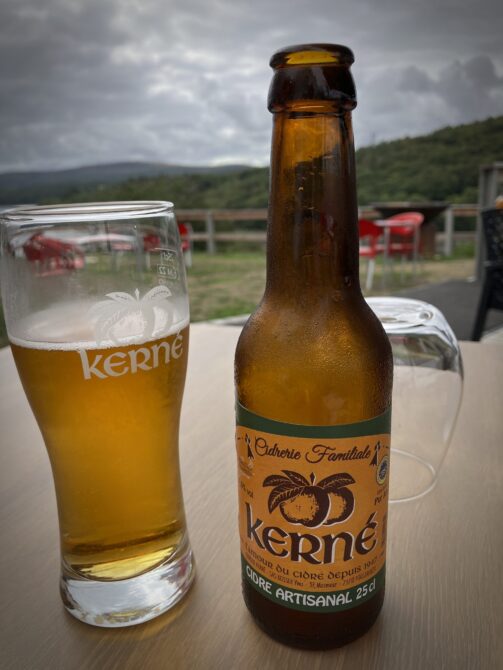
We have a little way to go, in Oregon, but we’ll get there.
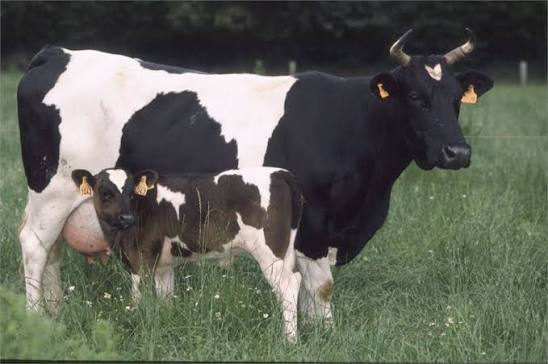
Next we continued through nice farmland, where I determined that the local breed of cow in Brittany is black-and-white piebald, as the British call it. I think they might be called the Bretonne Pie Noir. Pie Noir means “black magpie.” The internets say it thrives on poor soil and natural grass pasture, and makes very rich, high-fat milk. Could be why that whipped cream the other night was so amazing. I learned further that the breed was the subject of the first conservation plan in France, in 1976. I think it was worth conserving. It looks from a distance like the Holstein we have around Tillamook, but is much smaller. Not my photo.
Soon we crested a ridge and laid out below us was a stretch of coastline that is really not on the tourist maps, as far as I’ve seen.
We wound down through some little clusters of houses that were old, stone farming hamlets that may indeed be mostly second homes for wealthy people. But wealthy, low-key people.
The view below is toward a place called St. Nic. I have to say that this area felt really good, but it might just be because it reminds me of simpler times. I am developing a mania against mass tourism, which is silly in a way, because I still intend to visit places that other people want to see.
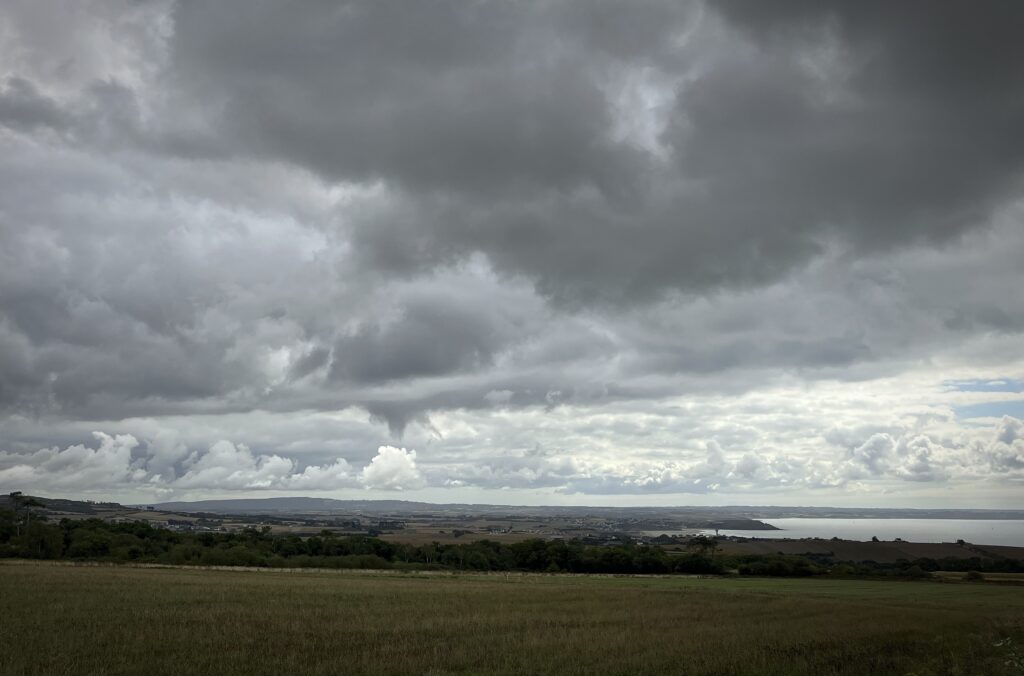
I feel like making a collection of forgotten places. I love them. But then, I fear they won’t be forgotten anymore.
The beach at St. Nic is called Pentrez. It may look pretty much exactly like the first beach, but it seemed different, as we were now further out in Finistère, nearly facing the full Atlantic Ocean. Finistère means “Land’s End.”
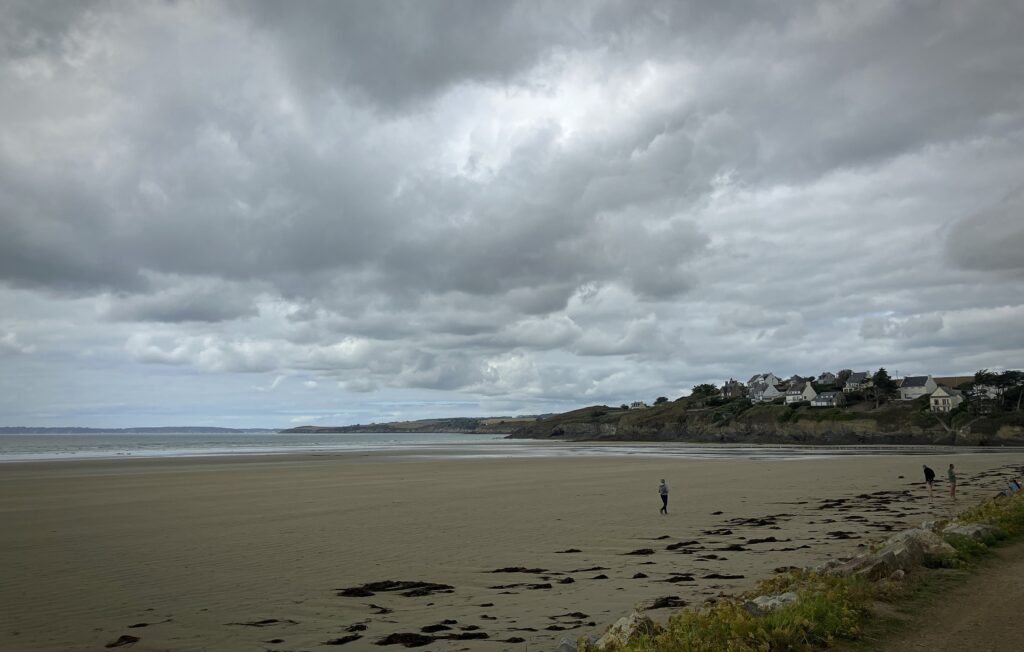
There were signs of high-season fun, like low beach carts with sails. You can skim along the sand just under the power of the wind. I could enjoy that. But things looked mostly put-away for the season. I think they get weekend traffic up until about the middle of September.
I’m now on the train heading east up the length of the famous part of the Loire Valley. It then goes south to Moulins-sur-Allier, blessedly missing Paris this time. We are back in the sunny climes and golden fields, and right now I can see the famous Chateau de Saumur towering up over the river and town. I haven’t seen it in 37 years, but it is still there! It is so imposing, even from the train station here across the river. It might be my favorite, of all the fifty thousand in France. I wanted to see it when I was 25 years old, because of how it looked in a calendar page of Les Très Riches Heures du Duc de Berry. It still looks pretty much the same.


