Perros-Guirec
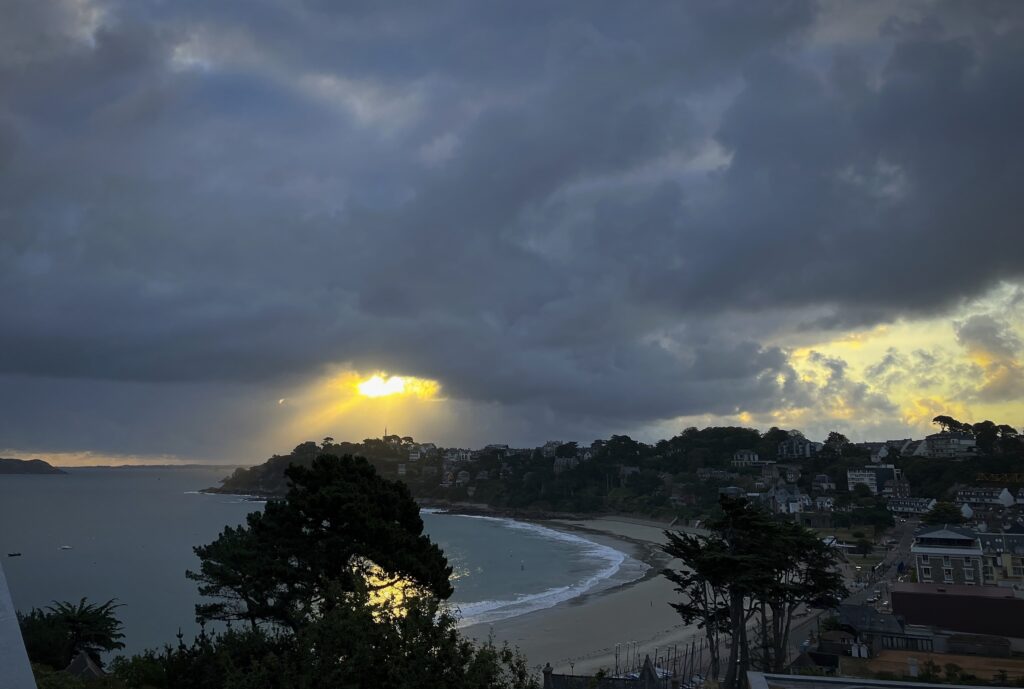
Perros-Guirec is spread over bluffs fronting three coves.
My cove is a beach, Trestraou, with pleasure boats and a casino. The original town fronts a larger cove that is called a port, in a rather loose definition of the word. And between the two lies a headland with a smaller cove containing a beach called Trestrignel. The steep hillsides that descend to each cove are completely covered in homes and condos. Yesterday I went to the Port, to have a nice lunch. It also has a marina, which you can see in today’s featured photo. It is enclosed with the wall, and a lock, to keep the pleasure boats, and other boats with deep keels in one safe spot when the tide goes out.
It looks to me like the port was always left bare at low tide, and the fishermen still let their boats lie on the beach at that time. Then they take dinghys out to their little boats when the tide is in.

I had decided to let AI find me a restaurant, as I’m tired of walking about peering at menus and hoping for the best. I told it I wanted traditional Breton food, but when it recommended crêperies I told it I do not like buckwheat galettes (which are a Breton specialty). Ok, it rolled with that. I told it I was dining alone, it seemed to empathize and switched up the results a bit. Finally I settled on a restaurant, and it recommended I make reservations. In most of France, lunch is a very popular restaurant meal, so I did. I turned out to be the only customer they had for lunch that day. The cook said goodbye and left as I was finishing my food.
But it wasn’t bad, and the main event, local seafood, seemed all right. A half-dozen local oysters from Les Ilôts de Bréhat, just a hop down the coast, and a locally caught sea bass grilled whole over oak charcoal were both fresh. At least, they tasted fresh, but I did have a distinct histimine-like rumbling in the lower intestine later on. There is a nice little building at the top of the port where the fishermen sell their catches, and this restaurant was a block or so down the street from it. The man said he chooses fish that will serve one, and mine took up a good-sized plate, its dead eyes staring upward. The salad and potatoes were decent. A light Chardonnay was perfect and the total was about 36 bucks. I am not sure the restaurant isn’t a bit of a money-laundering front though. The guys were from Tunisia, and gave me immigration advice to open a little business so I don’t have to renew my visa every year. We had quite a chat. But I’m not at all sure I’m going to use AI for restaurant advice too often. The adage “garbage in, garbage out” could not be more applicable.
I made a nice constitutional around the port of Perros-Guirec after lunch. Then, since I’d taken Hans out to make the trip, I decided to drive up the little headland to the smaller beach.

Today is panorama day; I don’t know what got into me.
At this beach, I took off my sandals and walked toward the water’s edge. Just as the sand became wet, I was stopped in my tracks by the oddest thing.

What is it?
I still don’t know for sure, but there was a nice display of local photographs up at the parking area, that showed Breton fishermen and women at work. I had also seen a man digging down in the wet sand at the Port as I strolled about.
There must be food still growing in these parts, aside from the one little field of cabbages some holdout farmer had at the top of the bluffs. This is one of the display photos, not mine.

A few steps more toward the water and all of the things I thought were rocks and clumps of seaweed turned out to be nothing but these funny signs of the life of some creature during the times of high tide, when the water clearly went all the way up to the seawall.
So perhaps if you wade out, they are sitting on the sandy bottom, evacuating their bowels in artful little piles. They must be big and also little babies, according to my field work.

Imagine just wading out every day and scooping up dinner. Now that is a useful economy, but no doubt forbidden these days without special permission.

Another photo from the display. I do wish I had seen lobster or scallops on any menus here in Brittany, but I have not. This scallop harvest will have to do.

At the pleasure boat marina there was also a nice series of large photos of the sailing champions who have come from this area over the last sixty years or so. Many in these photos have that blond-red coloring and large-boned build I’ve noticed in some of the people of the region.
In fact, I’ve noticed them in service jobs, mostly. My grocery checker was a very sweet, very tall and fair young man, and I’ve watched the middle-aged housekeeping maid leaving these condos with her cleaning supplies. She too is fair complected and probably a local. Could it be that the oppressed of western Europe are really still the Celts?
As I looked around the small and charming beach of Trestrignel, I noticed a lack of modern condos shoved in every available space. It was clearly developed for holiday-makers, but of a different sort.
The houses seem to mostly date from that late Industrial Revolution when massive new wealth sought out ways to be spent, and created so many watering holes and resorts. So does that mean that before that, say 150 years ago or so, the seacoast of Brittany was just a sprinkling of small stone fishermen’s cottages and farmhouses? All of this fresh, wild scenery and lush greenery and incredible marine bounty was enjoyed by a poor race subsisting amongst the boulders and mossy forests? It reminds me of my childhood on the Oregon coast, running free and unfettered on what felt like common land. All these changes in so short a time. The speed of it finally really hit me. Europeans have not really had a break since 1848.

No wonder they’re tired. They haven’t even had time to grieve every loss that change brings, no matter how positive it seems. And yet life does go on, and maybe it is simple curiosity that keeps people wanting to see how it turns out? And there are lovely moments to be had, like the sunrise from my balcony.