Ghent
Proper Shakespeare fans will know that John of Gaunt, the scheming ancestor of the Tudors…
…was born here. I think that the old English spelling indicates how to pronounce the town, rather than that he was extremely underfed. I asked three Belgians, and got three different answers. They play fast and loose with vowels in Flanders. And yes, it also has a claim to fame, and that is being at one time the richest city in Europe, and second only to Paris in size. It also is inland, like Bruges, with a long canal connecting it to the North Sea. Along with trading, I’m sure they took advantage to the invention of the stock market, and cashed in on industry of shipping insurance.
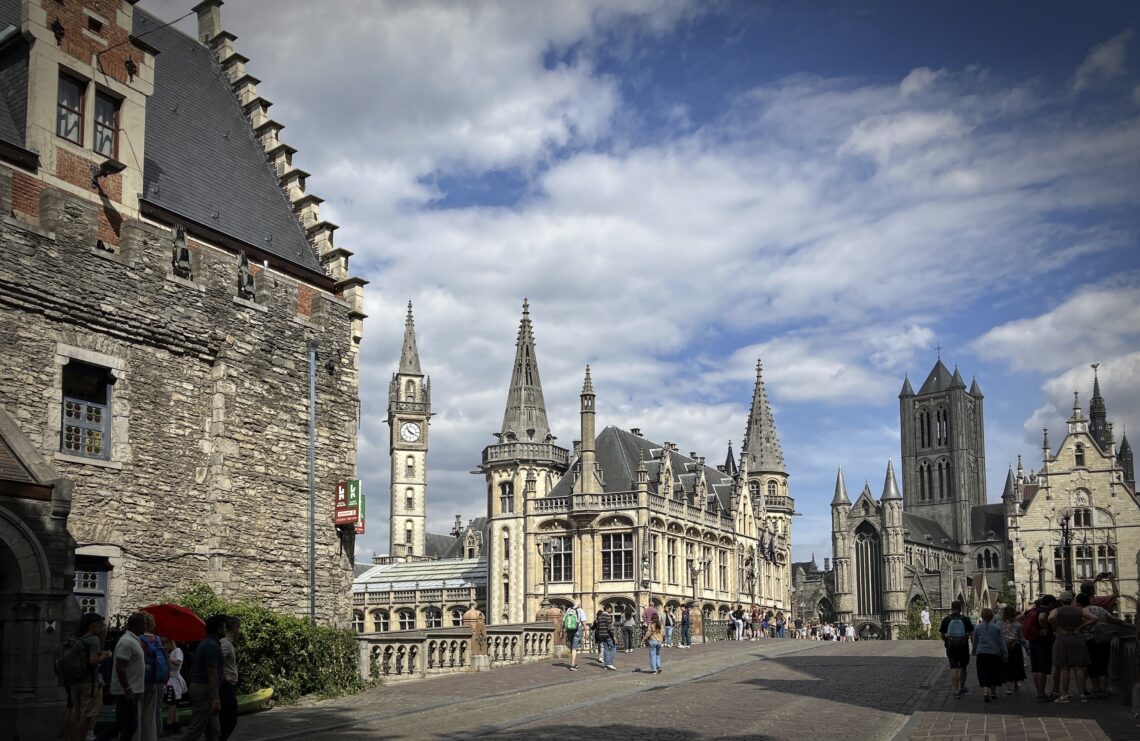
It also has a belfry, which is just visible in our featured photo, but is farther off, so doesn’t look so dominating. It is the tallest peak on the far right. This remarkable view is of my youth hostel, the gray stone building on the far left, the first time I saw it while trundling my suitcase over the cobblestones around the corner of a church. It was a marvelous location, but between four young male roommates there was bound to be one with reeking stinky feet, wasn’t there?
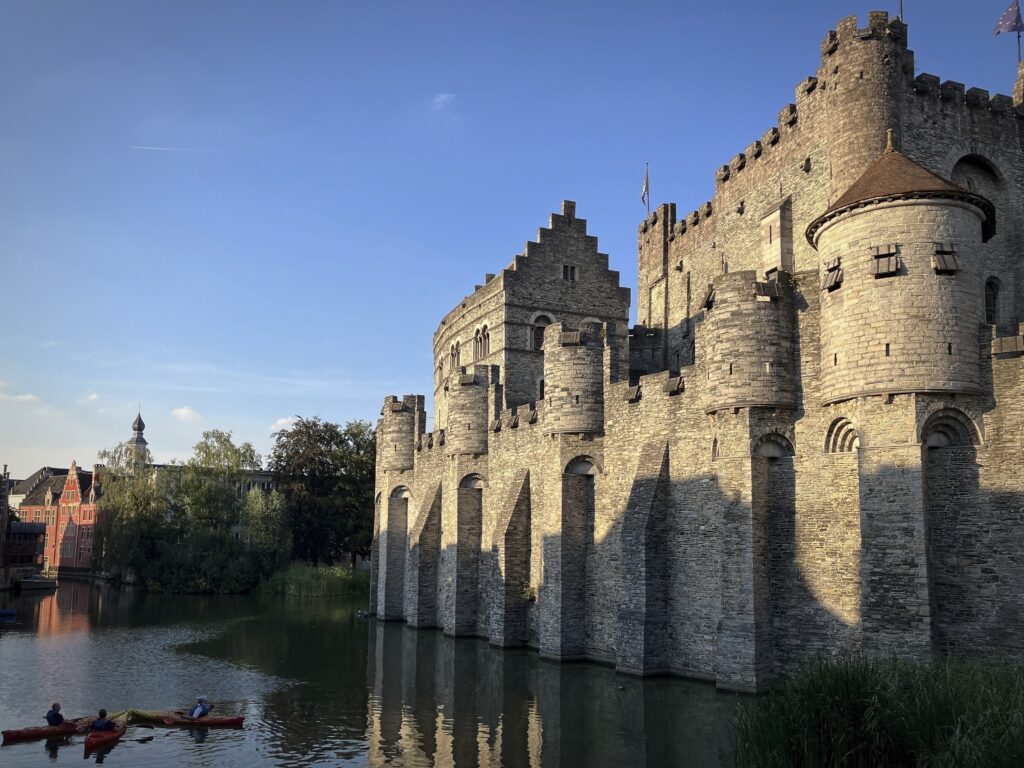
The splendor of Ghent can be taken in in one manageable stroll, with a stop for more Belgian beer. It still has a medieval castle at the confluence of a couple of small rivers, which features displays of medieval torture methods. I strongly dislike these kinds of museums, as well as the feeling of being enclosed in a solid cube of thick stone, so I stayed outside. The tomblike rooms in these defensive castles are quite a price to pay for safety; as if you need a reminder of where you’re headed.
All around it are “newer” buildings from the 1400s through 1700s, and the many individual examples are very beautifully decorated in symbolic and charming ways. Too many to share, but a delight to walk among. There is at least one canal, and with your growing mastery of Dutch, I’m sure you can read what is on offer, though I did not partake this time.
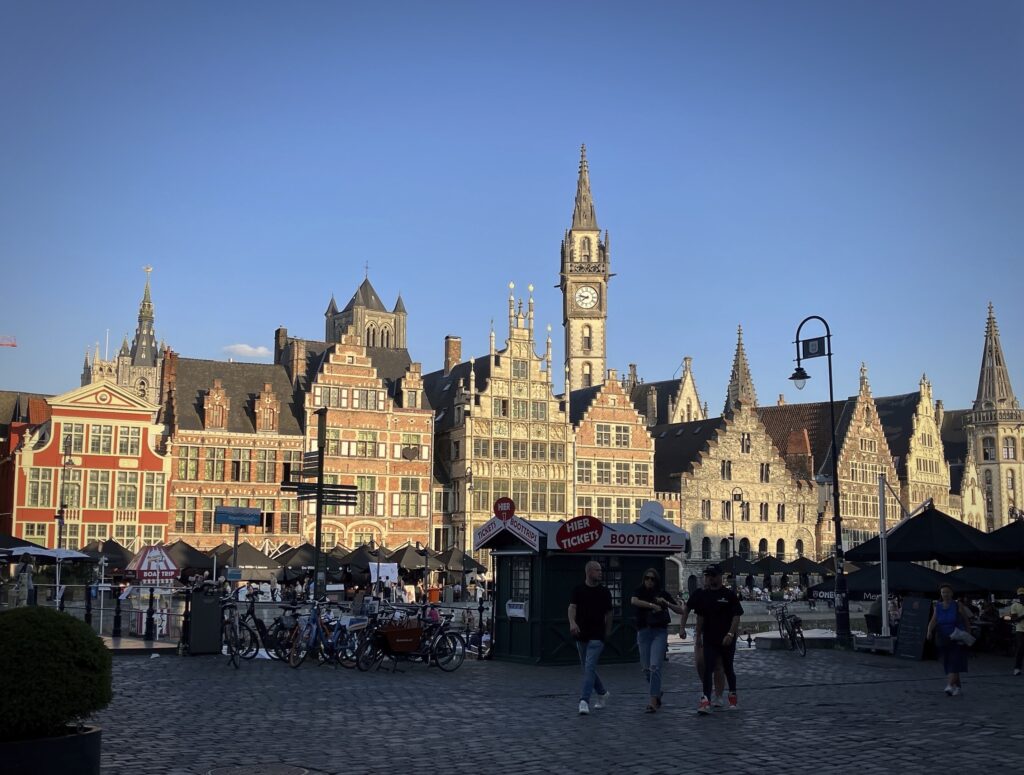
There are many squares, large and small, and I noticed that the statues of eminent men are not mounted on horses, as is the norm all over Europe. This area was dominated by the ‘burghers,’ who were the wealthy business class, and were not at all warriors. My indefatigable research department quickly informed me that the massive, tall belfries in each town were said to represent this new class, being neither defensive nor ecclesiastical in nature. It was explained as being a ‘win’ for the ‘common’ man, but these men were anything but common, really, as they still are not. They just represent the power of knowing the secrets of money.
One thing they are purported to be are carrillons, with many bronze bells. As I was walking near the belfry, I recognized the tune of Jaques Brel’s Ne me quitte pas (or “If You Go Away” when recorded in English) floating behind me in the air. Of course! He was actually a Belgian, not a French pop star, as many think. It made me smile and sing along. Score one for the burghers.
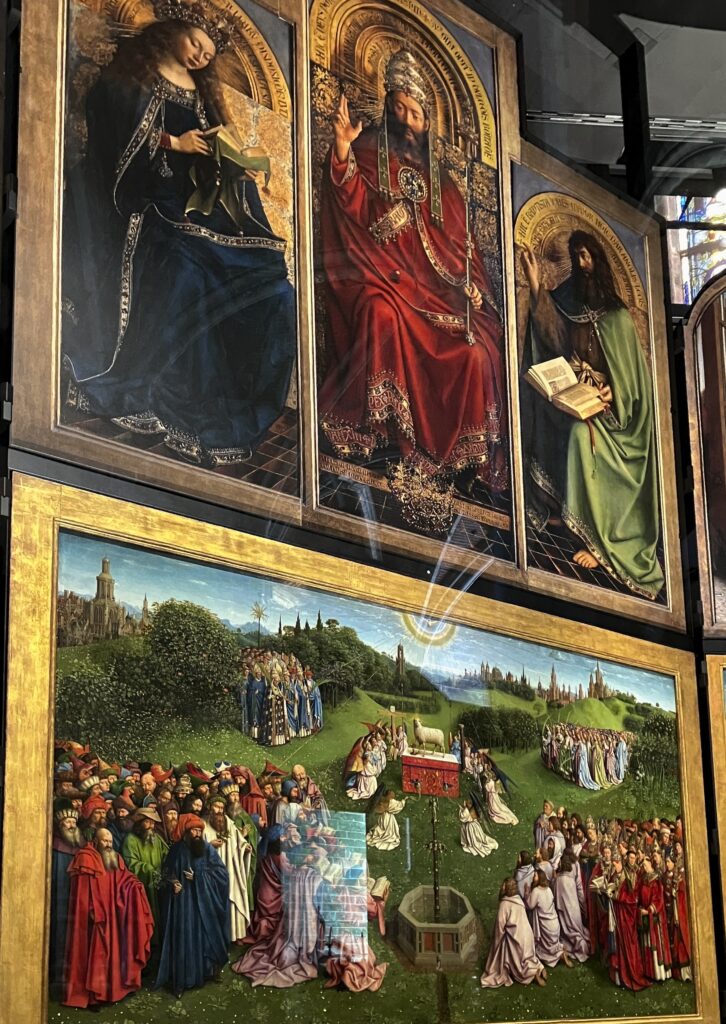
Now, nobody with any interest in art can come to Ghent and not go to see the great Ghent Altarpiece by the Flemish master Jan Van Eycke. He didn’t invent oil painting, as some used to believe, but he did “perfect” the use of it. He painted the altarpiece in 1433, and I rented the wonkiest virtual reality goggles to take a tour of the cathedral where it is located, to learn the history of the work. Like in all of northern Europe, the battles between Catholics and Protestants for supremacy were very long and intense in Belgium. The Catholics mostly won here, and the focus of trade and finance moved north to Amsterdam, where Protestants now dominate. At one point the cathedral was attacked by Calvinist mobs and all of the art was destroyed, but they thought to save the altarpiece by wrapping it in blankets and carting it off. After the destruction, the bishop at the time used “part of his personal fortune” to redecorate the church. He hired a guy named Peter Paul Rubens to make some new paintings, one of which is still hanging there. The later Baroque style he perfected in paint now dominates the interior of the church.
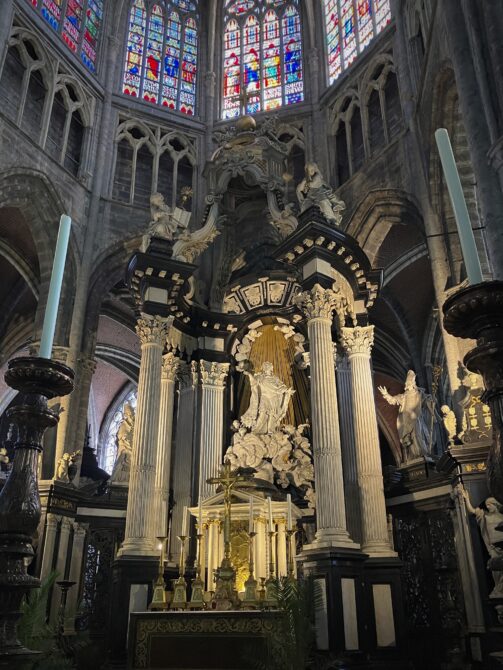
See? Just a part of a bishop’s personal fortune paid for this and much, much more? I don’t blame the Protestants kicking the Pope and his henchmen to the curb. What do followers of Jesus need with all that money? Let the businessmen keep their share, and make up a new doctrine of predestination to convince themselves they no longer need to worry about getting into heaven. They also legalized usury in their faith, by explaining that as long as an investment has an element of risk, it is a legitimate form of work, and thus not a sin.
I have no idea where we are now in that train of philosophy. Yes, I do have some idea.
But back before the Great Schism, somehow all these filthy rich burghers and their wives were actually convinced they could go to Hell, and the idea was terrifying enough that they paid for splendiferous things to buy their way to Heaven.
Thus, our stunning, freshly restored Ghent Altarpiece, with portraits of the pious man and his wife on the reverse of the closing panels. Hopefully God remembered their faces from this expensive gift.
And you know, I think that whatever all these thugs did to terrorize the populace into a fear of Hell and the Wrath of God wreaked havoc on their mental health. Because from the same place and era we have the nightmarish scenes of Hieronymous Bosch and the horrors and debaucheries that seem to accompany heavily corrupted capitalism. I wonder if they discovered adrenochrome?
And here is a peek at most of it, behind glass, with God himself in the center. It piques my curiosity about who was the model for Him? Nobody knows nowadays. Up close, you can see such detail as stained glass windows reflected in miniature in the jewels on their robes. All in 1433. Did our material culture indeed peak around this time?