Man and Nature
Some perspective is helpful when you’re trying to find your place.
I’ve about decided that Moulins is where I’m going to stay for the time being. That means I have decided, unless something comes up. This is hard, taking total responsibility for your entire situation. A long time ago, when walking in the woods of Oregon to ease my angst over people and decisions, I heard myself say to myself “Tell the truth, and go with the flow.” Now aside from my disappointment over the banal style in which I express myself, this really is a pithy piece of guidance, because I can’t help it anyway. And thus I was driven from my own home town, in a way. I chose to make myself rather uncomfortable there, perhaps.
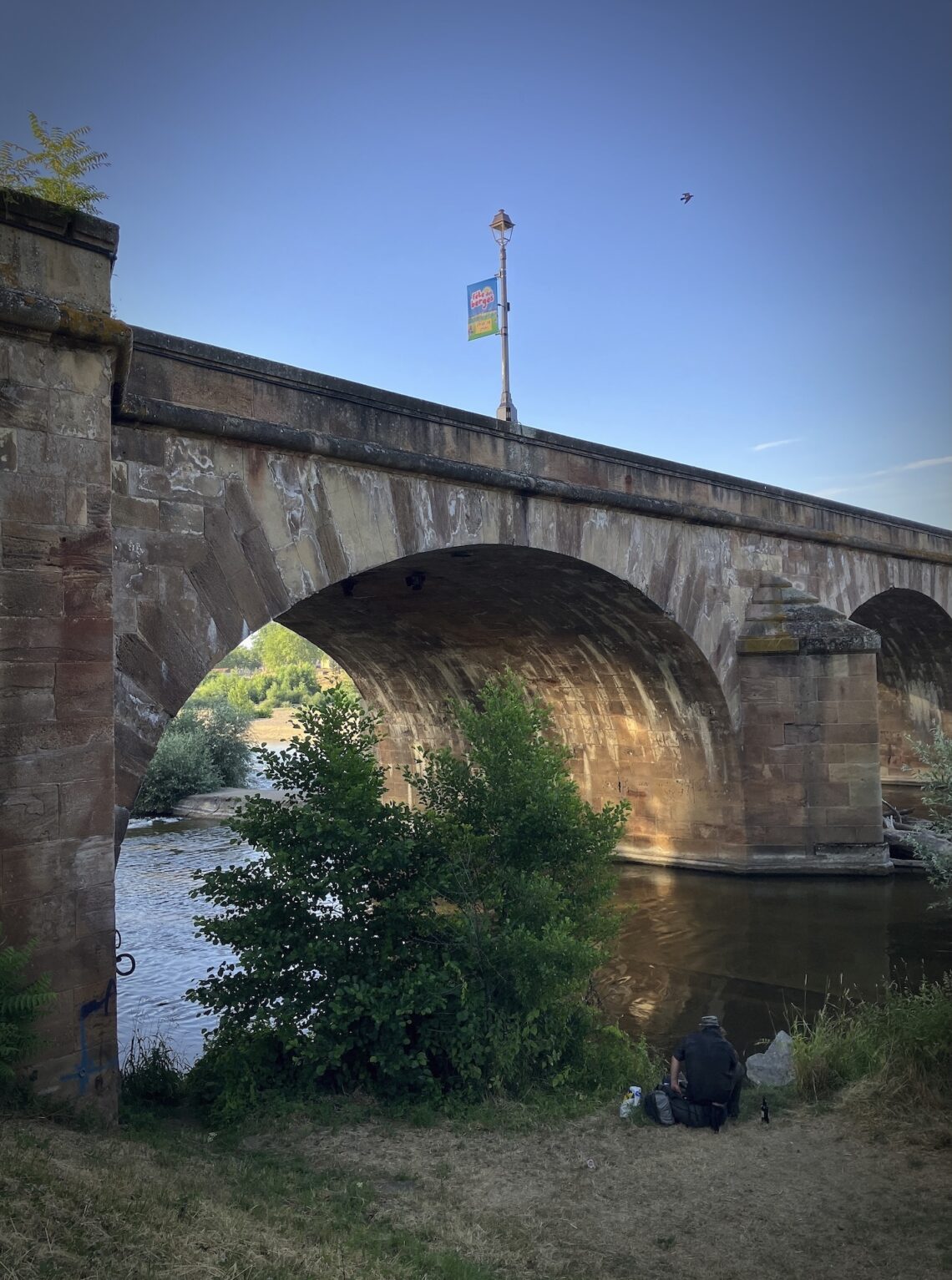
Taking more interest in my adopted town, I took some walks and took care of some business, and visited a museum recommended strongly by my hostess. I learned that the old bridge, the Pont Régemortes, was the very dividing line between Occupied France and Vichy France, in WWII, of course. On my side of the river it was Vichy, and Moulins just across was Occupied. In anticipating the arrival of the Germans, the mayor of Moulins wanted to keep the town open, to avoid unnecessary destruction, but was overridden, and so they blew up the arch featured in the photo. The Germans instantly built a wooden replacement and so later on the citizens had to rebuild it themselves. In the foreground is the one homeless man I’ve seen so far. They have banned tents in the city, to discourage them.
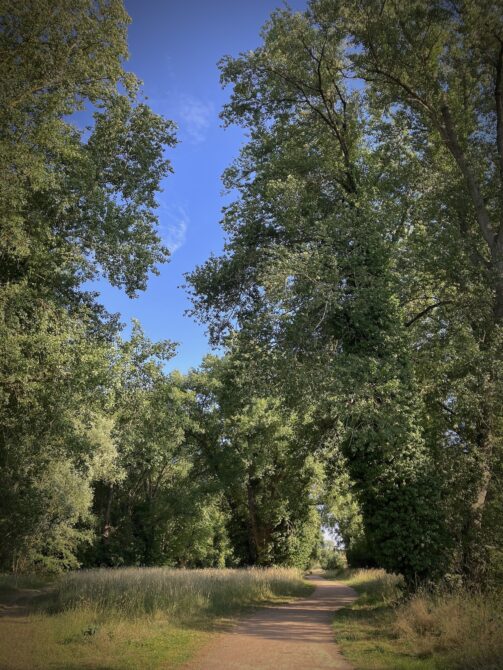 The Allier River here has a very nice path alongside, which suits me. There is a dock and a small swimming area too. There are birds, which sound nice, and in lieu of hummingbirds we get this astonishing insect. No idea what it is, but I hope you can see its long proboscis.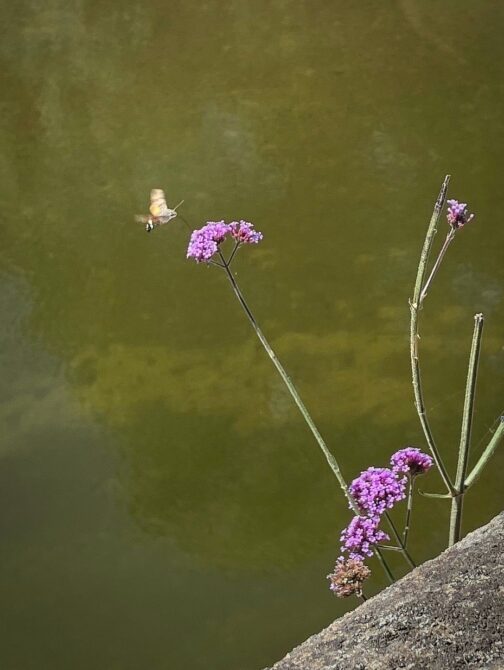
It was hot, but the RV park included, as you do here, a place for a shady drink, and I couldn’t pass it up. I kicked back with a cold glass of Sancerre, but the very young man who served me couldn’t help a quick glance downward, and so I removed my feet from the low, beaten-up wooden platform that served as a table. Sure enough, loungy as the seats are, nobody had their foot on a stained, weathered table. These people really are very polite.

Yesterday I visited museum in the home of a wealthy manufacturer during France’s Gilded Age, the Belle Époque. This era is not my favorite, but based on remants at Vichy and Paris, the French did it prettier than the British or Americans. Well, after seeing a fourth-tier salon of French paintings from the era, and the musty collections and fashionable “high-tech” appointments in his over-decorated house, I was left with a sense of horror. The subjects chosen by these late 19th century painters were rather morbid, and carried the tone nicely from the detailed death and decay in the medieval paintings in the adjacent room.
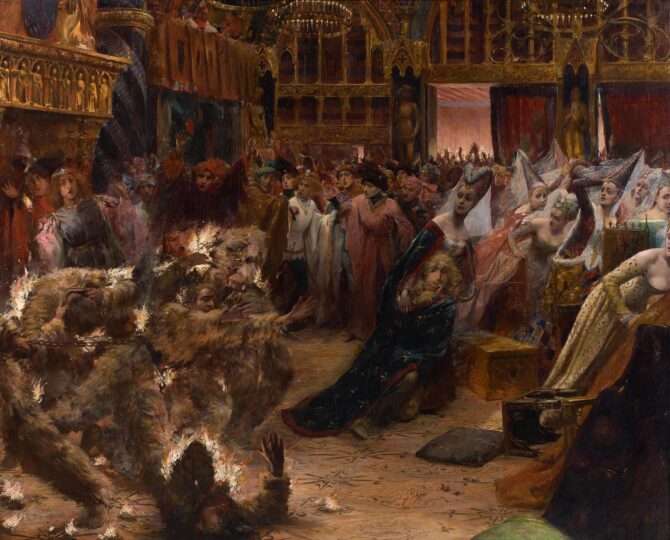
In the 19th century salon is a painting from a party given by the French king Charles VI, where he and his buddies came to the ball dressed as wild men. Their costumes entailed being covered head to toe in pitch-soaked linen, so that a sort of fur could be stuck to it. Some knights arrived with torches, and oops! The conceit of chaining all of the men, except the king, together, as you would with “wild men” meant that nobody could escape.
Yes, this really happened.
But I don’t know the story behind a painting of some pre-Roman era Gauls by the shore of the ocean, looking marooned and melancholy while the huge waves crashed upon the shore and a wolf-like dog howled at the full moon. I mean, what?
The collections in the house were, to me, mostly a bit pointless and decrepit. The cutting-edge comfort of the house looked like bits of a torture apparatus. And please explain: why would sentient human beings find it so amusing to look at real frogs turned into rapier-wielding fencers by a clever taxidermist? No image, j’en peux plus.
I think we get more of the truth of the state of things in obscure art museums, because that is the fate of the more embarrassing paintings. People in the 1880s and 90s were repressing (barely) a real sense of horror, and indeed, look what happened. The French were simply more sensitive, and it is more palpable. We are in an equivalent situation. Funny he chose to build his dream home in the middle of the ruins of a medieval fortress. Death and its cycles appeared to weigh on their minds, in the midst of such opulence.
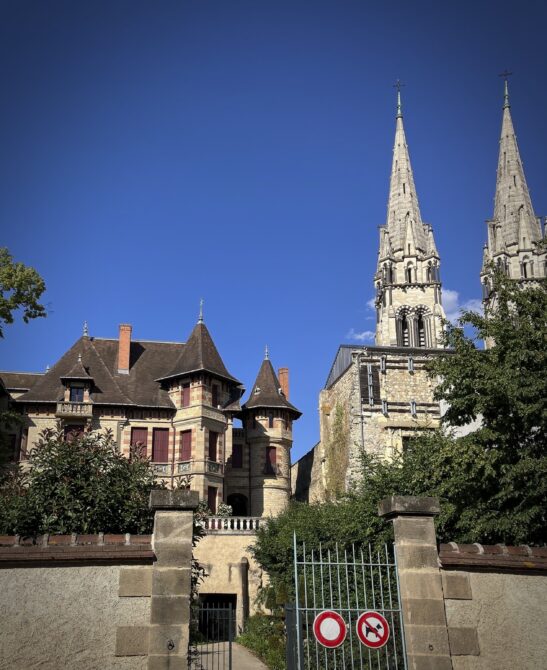
I now understand better the visceral hatred for their history that many contemporary French feel. The unabated, fiercely obsessive “curiosity” that undergirded such financial wealth in the Gilded Age was, and is, so vaunted. But it is a violation of sorts. The sight of people being swept up by excess and making tragic, horrible mistakes applies as a word of caution to us in the New World too. The French just have the ability to be more depressed about it all.
When I got home, and it had cooled enough to open the shutters and let in the night air, the sky was black except for the most beautiful conjunction I’ve ever seen. My equipment couldn’t capture it, but I take it as a gentle and positive sign. Venus brightly sitting atop a sliver of growing moon.
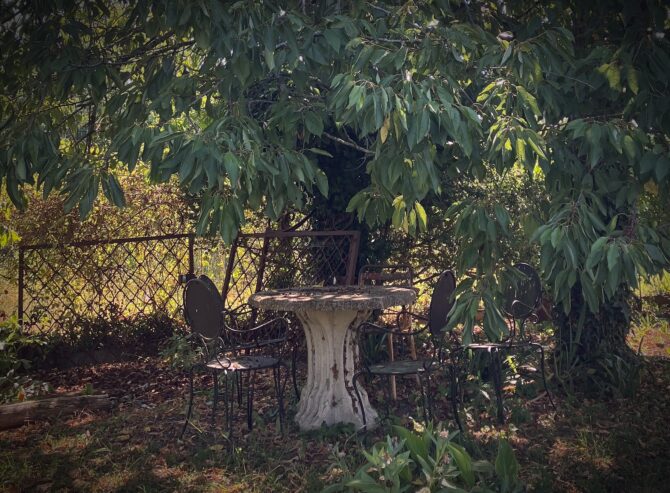
This morning I was looking for a place to hang up my washing, and came upon another table and chairs in the back of the garden. It reminded me of a copy of an Impressionist painting given to me by an old friend who is now dead by her own hand. Table Set in a Garden, by Pierre Bonnard. It has been in my bedroom at home, and is in the box to ship here when I get my own address. It symbolizes something for me, something simple yet always aspirational. I tried to capture it, and in memory of her, and others who loved me, and the beauty that accompanies the horrors of life, I’ll close with it.
Being here has already increased my belief that Fate is real, and humans just players. Americans don’t get that. We are headed toward another disaster. Let’s sit in the shade and raise a glass and not ever forget about love.