Remnants
Fragility is a fact of life that is mostly ignored, and perhaps for good reason.
No one knows what is to become of any of us, I suppose. And on that deep note, I’ll take you along the route I took after leaving the Rocky Point Resort yesterday morning. I do not know how the memory came to me, or where I first heard of them, but I found an old website that showed mare’s eggs. Yes, and so where were they? This old website, from the early 2000’s it looked like, described roughly where the spring is that has them growing in it. I zoomed in the map on my phone at about that spot, and saw some tiny words on one side of the road, and a spot of water connecting to the marsh on the other. Mare’s Egg Spring. It was north of us, along the edge of the marsh, coming out of the mountains on the west side of Klamath Lake, as are all the other springs. But this one is the only one that has mare’s eggs in it.
These are balls of algae that need a very specific set of conditions, and no human or other disturbance, to grow as big as a cantaloupe. They sit around on the bottom of the clear spring, and take ten to fifteen years to get that size. They have a tough skin and are like jelly inside, and have a special, tiny snail that lives on them and cleans them. Quite frankly, they sound disgusting. However, worth a look.
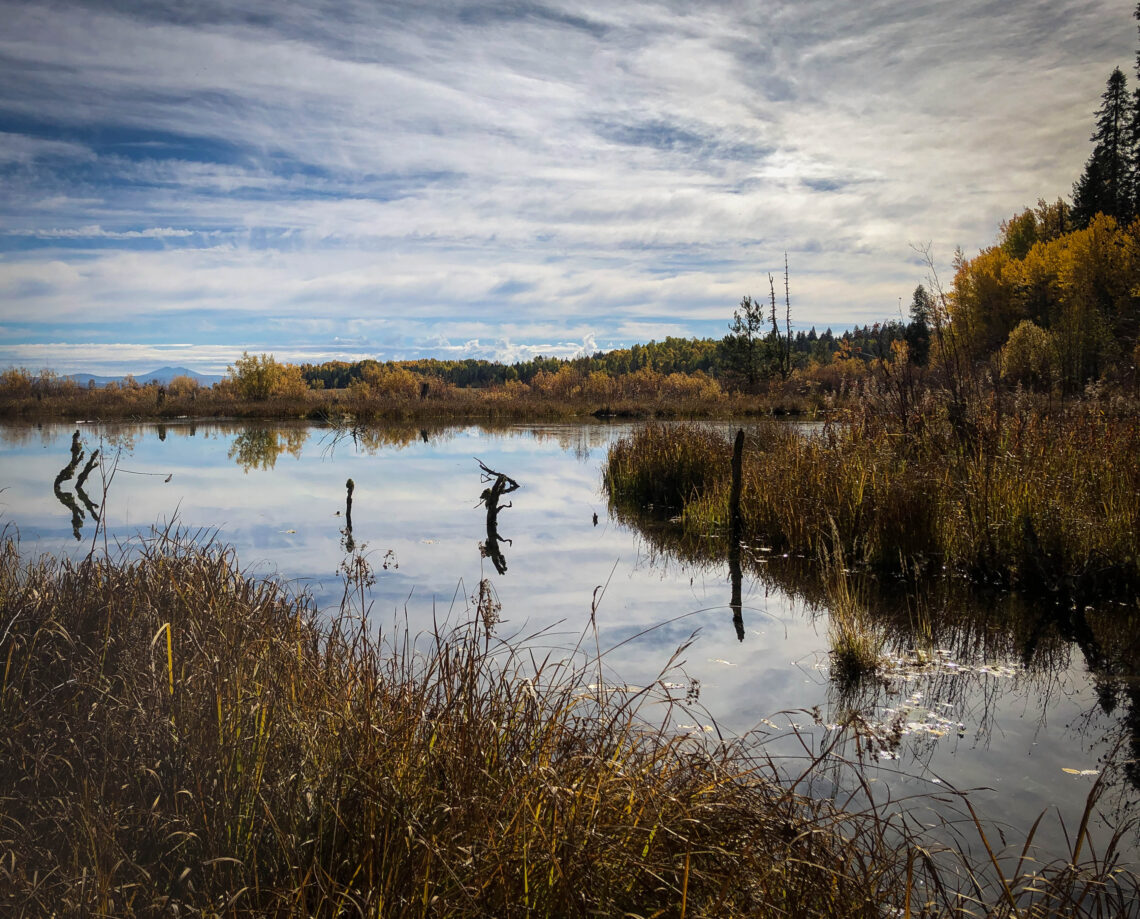
As I approached where I thought the spring would be, I saw nothing, and then a very small pullout, enough for maybe two cars, and nothing else. The photographs on the old website showed an interpretive sign, and the bottom of the spring packed with these dark green cantaloupe-sized balls of algae, or mare’s eggs. There was nothing there, but I thought I saw an indication of an old trail, and then threaded my way down through rushes and shrubs and trees, trying to guess if I was seeing a path or not. Soon I was at the water’s edge, and found that it was all tules and rushes and the water came up underneath them. But I could see I was at the spring, and where it leads into the marshes is our featured photo.
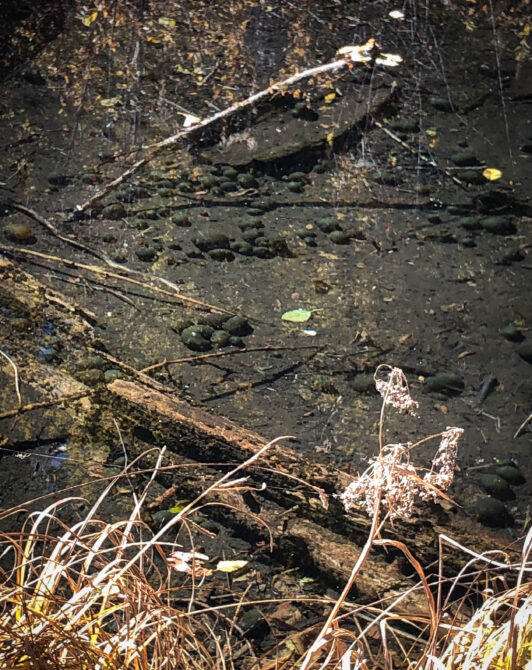
According to the internets, it was five years ago that there were lots of them, and they were huge. Now you can see from the not-very-good photo I took that there are a few, and they are small. Perhaps some total mouth-breathing cretins came and ruined them all, or took them away, which amounts to the same thing. Or maybe the conditions are suddenly not so perfect for these rare life forms. These will grow and split and one day it will be all full again, if things go well. Or not.
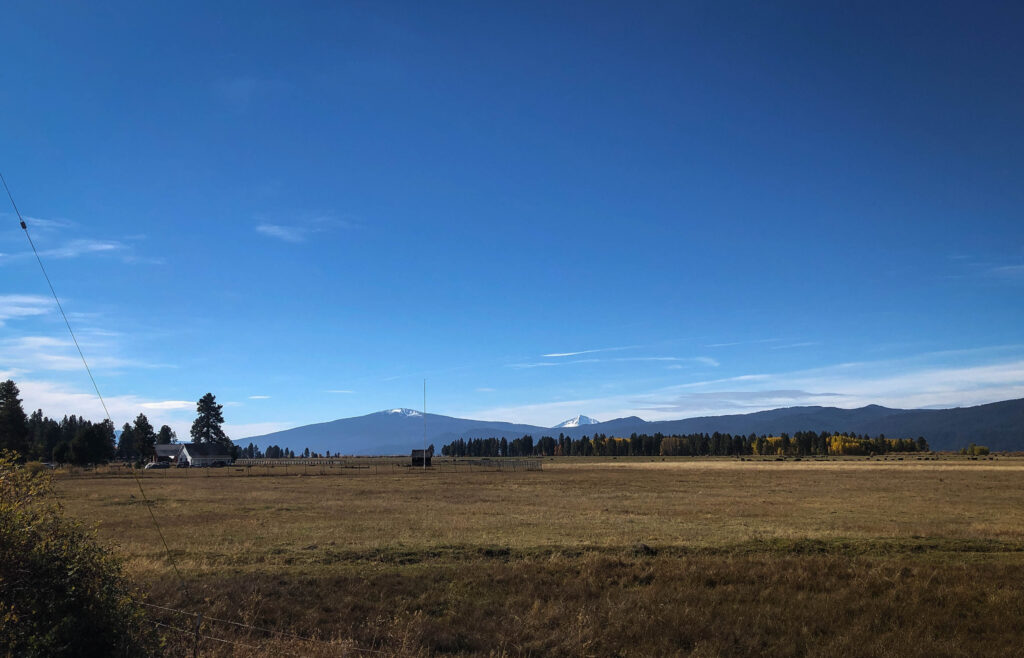
I continued on north until the marsh refuge ended and turned east to cross over toward the highway I would eventually take home. The marsh gives way to miles of flat pastures, and many ranches, some next to the road. In the distance could be seen the tall cottonwoods and poplars that indicated other ranch homes.
Then the road went north and came to Fort Klamath. This is a group of about two or three streets, some houses, two motels, only one of which was open, a pretty classic white board church with a metal roof, even on its steeple, an abandoned old wooden hotel or dormitory, an abandoned old wooden gas station, and a post office. No food. I turned around and went out of town and soon came upon a historical marker.
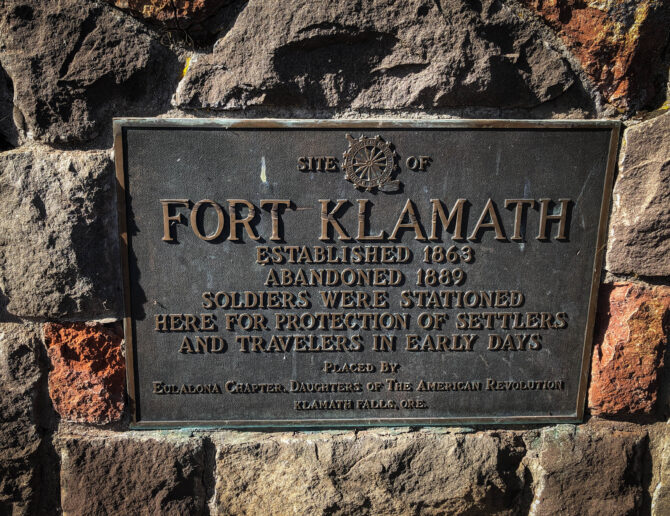
The fort is gone now, and looks like it only was used for about twenty years or so. The settlers were being protected from the Klamath Indians, who lived in these parts. I remember reading that one of the worst wars between the settlers and the Indians was the Klamath-Modoc War.
I looked out over the valley, and could see what I was pretty sure was the historical museum, not far away. The Phone Lord had said it was Temporarily Closed, and I imagined it was for the season, since who comes out here anyway? As I drove Janet up to the gates, a car was leaving, and one side of the gate was open. I thought this was my lucky chance to at least park and walk amongst the buildings they had there, and hopefully find the cemetery.
A young man was walking up as I was getting out of Janet. He had on a baseball cap, was in his 20s, and informed me that it was closed because they were having a special ceremony. He did not look full-blooded Indian, but probably half. I could see a group of people over on one side of the grounds, but since I felt ruder than intended, I did not try to look at them. I apologized and said I’d be on my way. He told me that they were just finishing five days of ceremonies with a sweat lodge, and I said I hoped all went well, and once again I was very sorry to interrupt. He grinned and said “You’re fine, no worries!” and closed the gate after me. Turns out their story has its ups and downs and is on Wikipedia, but their reservation has only about 350 acres and there are nearly six thousand registered tribe members, up from zero on both counts, after the feds ended their tribal status in the 1950s. They mostly live over in Chiloquin, but maybe this is a special spot. You can see Mt. McLoughlin peeking up back there, which is very nice.