Applegate Trail
The first road through southern Oregon was made by Jesse Applegate and his brother.
It then became Highway 99, and later Interstate 5. I decided to take the most beautiful days of the whole autumn to drive down to the Medford area and cross the Cascades on the one state highway over the mountains that I had never been on, Hwy. 140, that goes over to Upper Klamath Lake. Yesterday, Janet and I got out in the morning and I tried to take every remnant of the old Hwy. 99 that still remains, all the way south to Medford. I think I caught most all of them, and it did entail jumping on to I-5 from time to time, where the old highway was covered up due to mountainous terrain and narrow valleys.
The first thing I discovered is that some of the places in Lane and Douglas counties alongside Hwy. 99 are collections of desperately poor people, living in old RVs and rotted cottages. Curtin was particularly notable. The highway serves as a backwater of sorts, where the poor and overlooked are collected in heaps of mossy detritus. People walking alongside the road are often seen. Old RVs are becoming anathema to many reputable RV parks, and I was less confident when we set out this time, since of course Janet is very old indeed. She’s 36 this year.
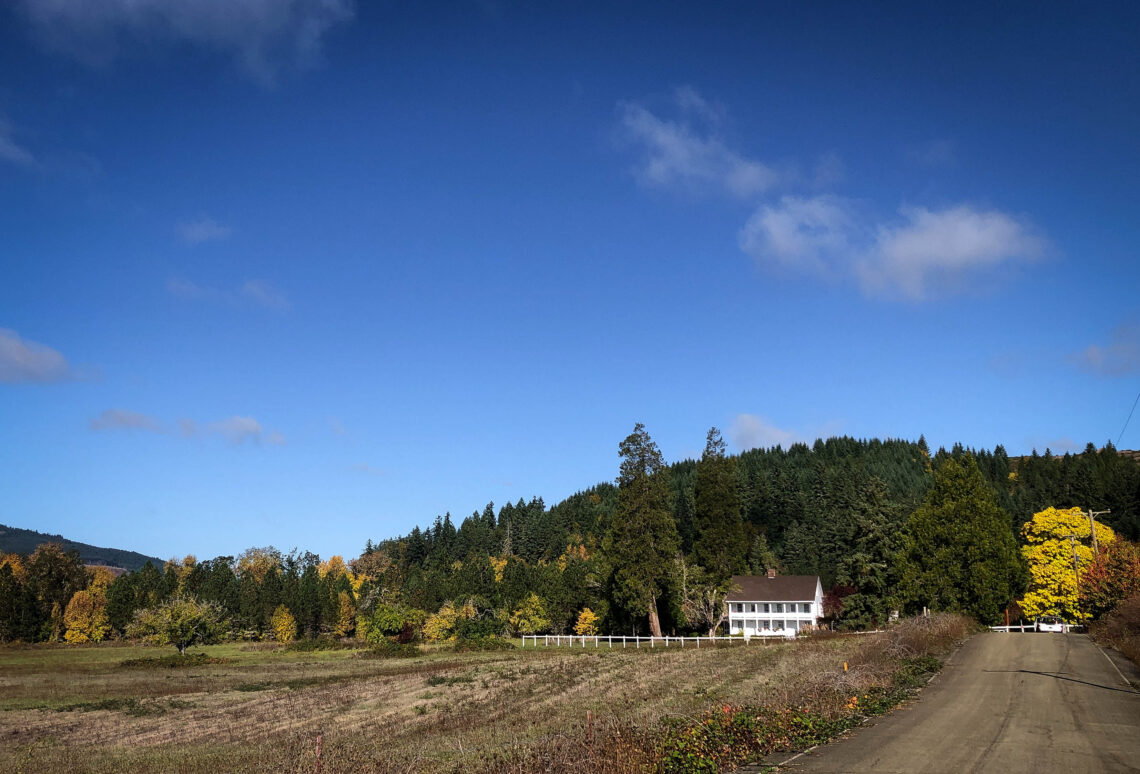
The town of Yoncalla was in a rather nice little valley, and I set out to find a historic house I knew was nearby. When I got to the end of the road, the most extraordinarily friendly public worker, who was, weirdly, there to remove some graffiti on the asphalt by the house, was delighted to introduce me to the man who lives next door to the house, in our featured photo: the Charles Applegate House. The man’s wife is the great-great granddaughter of Charles Applegate, whose brother Jesse was a key figure in Oregon history. The man said it is the oldest house still owned by its original family in all of Oregon. The three Applegate brothers all ended up settling in this valley, but Jesse Applegate’s house up the road is now gone. A historic roadside marker explains who he was and where it was.
Originally they homesteaded in the Willamette Valley, coming in on the first wagon train of 1843, I think is the date. Jesse’s son had drowned in the awful run down the Columbia River that the wagons had to make to get past Mt. Hood, and so after settling near his brothers, he decided to go and make a trail that bypassed that treacherous northern piece, by going southwest to near the California border and then north. Charles was the least adventurous, so stayed back to help the wives and many children.
Jesse was also one of the men that voted in the first American government on the West Coast, at Champoeg. So how did the Applegates all end up down here? Apparently the Applegate Trail was so difficult, and caused such problems for the families who first used it, that Jesse was harshly criticized in the Oregon press, and there were very hard feelings all around. So all three of them and their families just resettled down here. So said his great-great-grandniece’s husband. I think there has to be a little more to the story, as this area can’t touch the Willamette Valley for prosperity and social options, but maybe that was the point.
Many little communities on Hwy. 99 looked lovely, if not just because it was an absolutely perfect autumn day. The red and golden leaves, in some places hanging over the narrow highway, the brilliant blue sky, the warm sunshine, all made the towns look more heavenly than usual. Even Riddle looked pleasant, though I was the only traffic and I saw only two people out of doors. They both had their hoodie sweatshirts with the hood pulled over their head and faces, and were looking down, walking. It is like a uniform of utter downtrodden pointlessness.
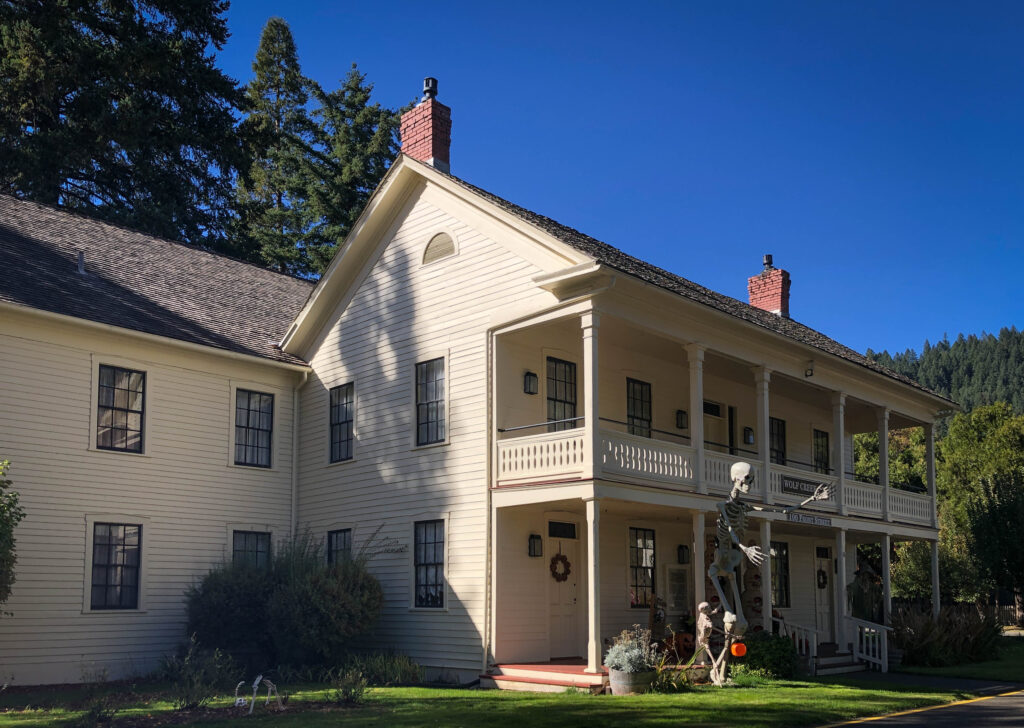
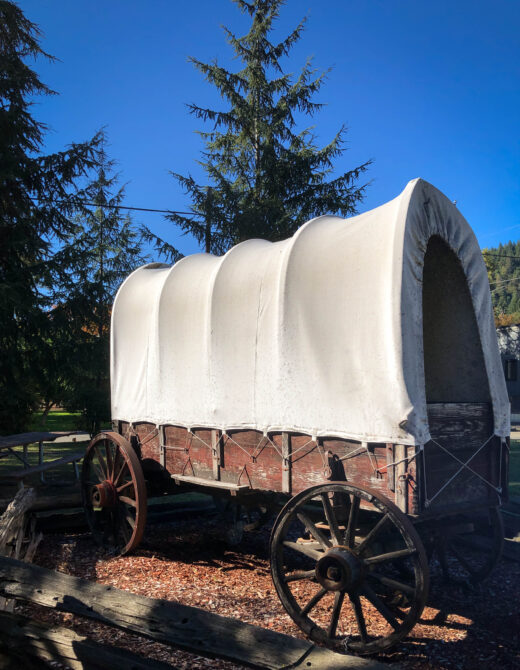
The worst part of the Applegate Trail is the section of I-5 that goes past Wolf Creek, Oregon. This is a stretch of steep, mountainous land, with narrow, thickly forested canyons. After the trail was fairly well established, someone put an inn in the middle of this section. In the 1920s, the inn got an addition, when the road was first paved for the new motor cars. It is called the Wolf Creek Tavern, and I’ve eaten there once, in 1988, and since then it has been closed every time I’ve stopped. As it was yesterday. A peek through the windows looks interesting; very raw frontier style, but with many coats of paint. This visit I walked through the little interpretive display across the drive, and saw a replica of a wagon first used by these settlers, and an excerpt from one pioneer’s diary telling about how bad he felt watching his wife walk with the wagon through this wretched trail in the pouring rain. He said she didn’t complain, but looked bad. Maybe she up and died.
Just north of Medford, with the Bear Creek Valley laid out ahead of us, and Mt. McLoughlin presiding over it with its freshly snow-dusted peak, we turned off for the road across to the foothills of the Cascades. The land looks much different, more like northern California.
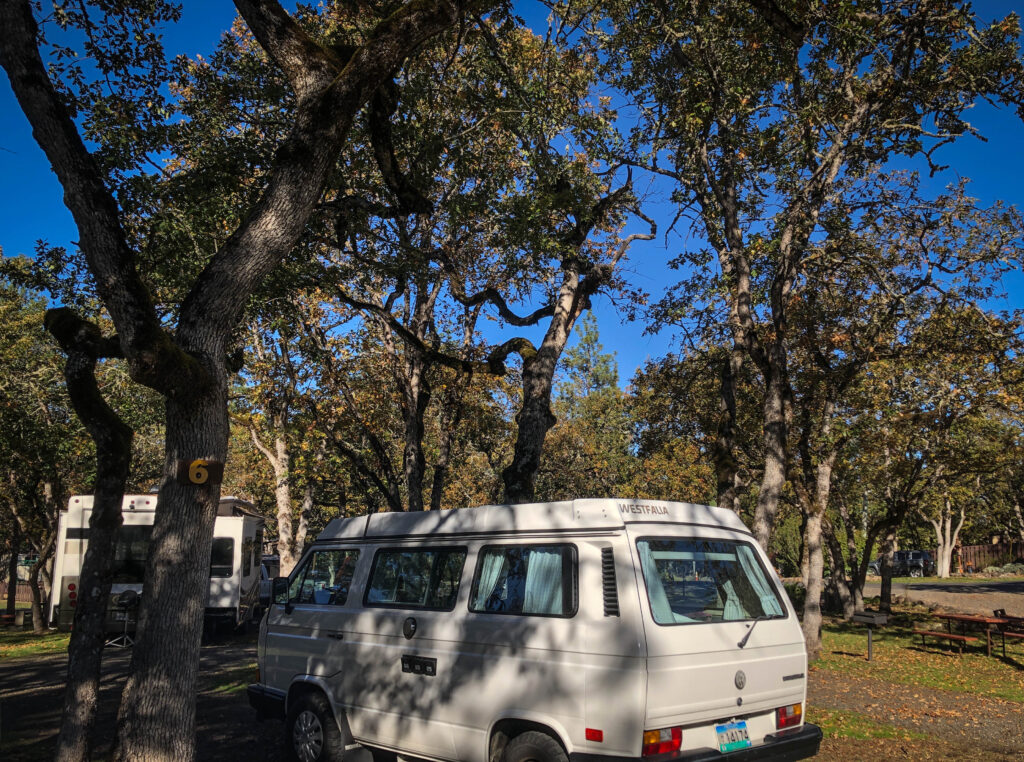
This morning, I’m here in Janet, at Medford Oaks RV Park, made in the 1940s on a knoll east of town, with white fences and graveled lanes through the ubiquitous, little black oaks. The majestic Oregon white oak is not seen down here, apparently. The man who runs the park was very friendly and chatty, and talked about the problems with theft and drugs in Medford. Apparently Oregon does not prosecute theft unless it is valued at over $1,000. Large groups of people, say 10, he said, will go in to a Walmart and grab a lot of stuff and only a couple of them will be detained, and will only get a ticket, which I imagine they ignore. He does background checks on people who want to stay longer than a couple of weeks. But apparently we were acceptable.
Last night was cold, but my heater buddy is now working like the charm it is, and I’ve enjoyed the brilliant sunshine streaming sideways through the twisted oak trees that we are camped amongst. Birds and squirrels and finally a couple of deer, in their winter coats, have drifted past the one window whose curtain I always open to enjoy while reading and drinking my coffee.